
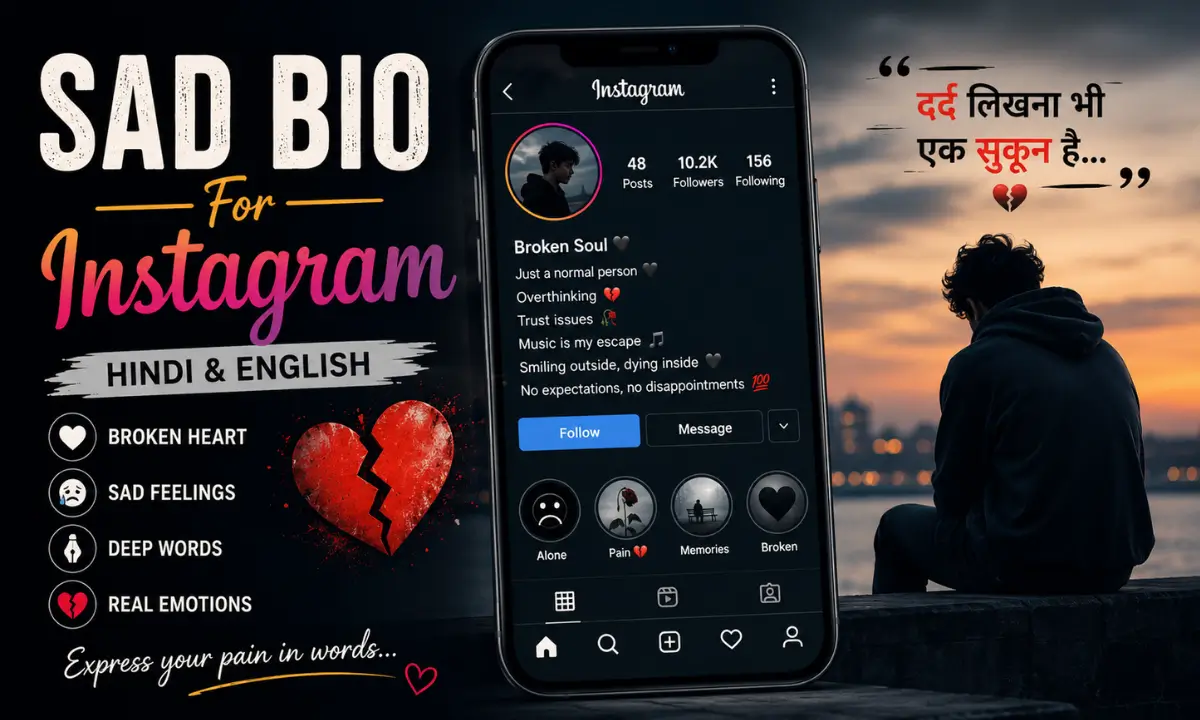
Sad Bio for Instagram in Hindi & English: 100+ Deep Emotional Ideas (2026)
Not every Instagram profile needs to look happy all the time, and there’s nothing wrong with a bio that reflects exactly where you are right now. This sad bio for instagram collection is split into five moods — Hindi, English, alone, broken heart, and deep emotional — with 20 bios in each, so you can find something that actually matches what you’re feeling instead of a generic line that doesn’t quite fit.
Most sad bio pages online mix every tone into one undifferentiated scroll, which makes it harder to find the specific flavour of sad you’re actually going through. Heartbreak reads differently from loneliness, and loneliness reads differently from a quieter, more reflective kind of sadness. This page keeps those tones separate on purpose.
- Why People Search for Sad Bios — and Why That’s Completely Normal
- Understanding the Different Tones Below
- How to Login & Update Your Instagram Bio (Step-by-Step)
- Sad Bio in Hindi
- Sad Bio in English
- Alone Bio
- Broken Heart Bio
- Deep Emotional Bio
- Mistakes to Avoid When Sharing How You Feel
- When a Bio Isn’t Enough
- How This Collection Was Curated
- Frequently Asked Questions
Why People Search for Sad Bios — and Why That’s Completely Normal
A sad bio is usually a small, private way of processing something, not a cry for attention. Putting a feeling into a few honest words and quietly placing it on your profile is a common, healthy form of self-expression — the same way people have always turned to journals, songs, or shayari during hard chapters of life. Search interest in sad bios doesn’t spike because people are performing sadness for an audience; it spikes because a short line under your name is one of the lowest-pressure ways to acknowledge a feeling without having to explain it to anyone.
If what you’re going through feels heavier than a bio can hold, though, it’s worth talking to someone you trust or a mental health professional. A bio is a small outlet for expression, not a substitute for real support when you genuinely need it — and there’s no contradiction between using a sad bio for a while and also reaching out to someone in your life at the same time. Also try: Husband Wife Jokes in Hindi & Funny Comments on Friends Pic in Hindi
There’s also nothing unusual about wanting the words to be exactly right. Sadness is often hard to explain out loud, and a short, carefully chosen line can sometimes say what a longer conversation struggles to — that’s not avoidance, it’s just a different, valid way some people process what they’re feeling before, or instead of, finding the words to say it directly to someone else.
Understanding the Different Tones Below
Not all sadness reads the same, and grouping every sad line into one bucket loses that nuance. Here’s roughly how the five categories on this page differ from each other, so you can pick the one that actually matches your mood instead of just the first sad-sounding line you see.
Hindi sad bios lean on the emotional weight that words like “tanhai” and “dard” carry culturally, often echoing the tone of Bollywood lyrics or shayari — they tend to feel more poetic and less literal.
English sad bios are more direct and plainly stated, which suits profiles that want the feeling clearly readable without any cultural or poetic filter in between.
Alone bios aren’t always sad in the traditional sense — several of these lean toward peace and self-sufficiency rather than loneliness, which is worth noticing if what you’re actually feeling is more “quiet” than “hurting.”
Broken heart bios are specific to relationship or friendship endings, and carry a different weight than general sadness because they’re tied to a particular loss.
Deep emotional bios are less about one event and more about how you process feelings in general — these suit reflective, introspective profiles more than a specific recent heartbreak.
Reading through all five before picking one is worth the extra few minutes. It’s easy to default to whichever category is listed first, but the actual fit between your situation and the tone of the words makes a bigger difference to how “right” the finished bio feels than almost anything else covered on this page.
It also helps to notice that these five categories aren’t strictly separate from each other in practice — a broken heart often carries a version of loneliness with it, and a deep emotional line can just as easily describe the aftermath of a specific breakup as a more general low period. Treating the categories as starting points rather than rigid boxes usually leads to a better match than forcing your situation into whichever label technically fits closest.
A Note on Timing and How Feelings Actually Move
Sadness rarely arrives and leaves on a predictable schedule, and a bio that felt exactly right on a Monday can feel like an exaggeration by Thursday, or not nearly enough by the following week. That’s not a sign anything is wrong with how you’re processing things — it’s simply how emotions tend to move, in waves rather than straight lines, and a bio is allowed to move with them rather than staying fixed to whatever felt true the day it was chosen.
Some people find it useful to keep a small note of a few different lines they connect with, from a few different categories on this page, so that updating the bio to match a shift in mood takes seconds rather than requiring a fresh search each time. There’s no wrong way to use this collection — whether it’s one bio kept for months or a different one nearly every week, both are equally valid ways to use it.
How to Login & Update Your Instagram Bio (Step-by-Step Guide)
Here’s the full process for updating your bio, from logging in to saving the final version.
Step 1: Log Into Instagram
Step 2: Go to Your Profile
Step 3: Tap “Edit Profile”
Step 4: Replace Your Bio
Step 5: Add Line Breaks if Needed
Step 6: Save
For account recovery or anything beyond a simple bio edit, only use Instagram’s own official Help Center — avoid any third-party site offering to “recover” your account or “boost” your engagement in exchange for your login.
What We Found Looking at Other Sad Bio Pages
Reviewing the pages currently ranking for sad bio searches in both Hindi and English showed a consistent theme: Hindi sad bios draw heavily on Bollywood lyric traditions and shayari-style phrasing, using words like “tanhai” and “dard” that carry more emotional weight in Hindi than their literal English translations do. Pages that acknowledge this cultural difference, rather than simply translating English sad lines into Hindi, tend to feel more genuine and are the ones people actually copy and keep using.
Most competing pages, though, treat every kind of sadness as interchangeable, mixing loneliness, heartbreak, and general low mood into one long list with no distinction between them. Very few pages pair the bio list with any acknowledgment that this is a genuinely sensitive topic for some readers, or offer any gentle guidance beyond the bios themselves. This page does both deliberately — the tones are kept separate below, and a short supportive note sits alongside the collection rather than being left out entirely.
Sad Bio in Hindi
Hindi carries a certain weight in sad lines that a direct English translation often loses — these are written to hold that on their own, without needing to be understood as a translation of something else.
दिल टूटा है, आवाज़़ नहीं 🖤
मुस्कुराहट के पीछे दर्द छुपा है 💔
अकेलापन अब आदत बन गई है 🥀
टूटे ख्वाब, अधूरी कहानी 💔
हर रात खुद से लड़ता हूं 🌙
दर्द बयां नहीं होता, बस सहा जाता है 🖤
खामोशी में भी एक दर्द है 🥀
जो चला गया, वो याद बनकर रह गया 💔
टूटा दिल, अधूरी कहानी 😞
आंसू छुप जाते हैं, दर्द नहीं 💧
अकेले चलना सीख लिया है अब 🚶
उम्मीदें टूटी, हौसला नहीं 🖤
हर मुस्कान के पीछे एक कहानी है 🥀
जो दिल पे बीती, ज़ुबान पे नहीं आई 💔
साथ छूटा, यादें रह गईं 🌧️
टूटकर भी संभलना सीख लिया 🖤
दर्द को अपनी ताकत बनालिया 💪
कहानी अधूरी रह गई, दर्द पूरा रह गया 💔
खुद से बातें करता हूं, अकेले में 🌙
जो बीत गया, उसे याद कर कभी कभी रोता हूं 🥀
Sad Bio in English
For profiles that want the same honesty in English, without leaning on filmy or poetic phrasing to carry the feeling.
Behind my smile is a story you wouldn’t understand 💔
Silence is my only friend now 🖤
Broken but still breathing 🥀
Some nights the tears just fall without a reason 💧
I healed, but I still remember 🖤
Empty inside, smiling outside 🎭
Not okay, but pretending to be 💔
The pain is quiet, but it’s always there 🥀
I lost myself trying to hold onto you 💔
Some scars don’t show but never fade 🖤
Learning to breathe again, slowly 🌙
My heart still whispers your name sometimes 💧
Loneliness taught me things people never did 🥀
I’m tired of pretending I’m fine 🖤
Some stories are better left unfinished 💔
I gave my all and got left with nothing 🌧️
It’s okay to not be okay 🖤
Still healing, still hoping 🌱
My silence holds more than my words ever could 💔
Broken crayons still color the same 🖤
Alone Bio
Not every “alone” line is sad — some of these lean toward peace and quiet self-sufficiency rather than loneliness, and it’s worth reading through with that distinction in mind before picking one.
Alone but not lonely, learning to love my own company 🌙
I found peace the day I stopped waiting for people 🖤
Solitude is my safe space now 🌌
Learning to be my own best friend 🤍
Alone is better than being surrounded by fake people 🖤
My own company is enough for me now 🌙
I walk alone, but I walk at peace 🚶
Silence taught me who really cares 🖤
Alone doesn’t always mean sad, sometimes it means free 🌿
I stopped chasing people who don’t stay 🖤
Being alone helped me find myself again 🌙
Not everyone deserves a seat in my life anymore 🖤
I’m my own home now 🏡
Some journeys are meant to be walked alone 🚶
Alone, healing, and okay with it 🌿
My peace matters more than company now 🖤
I learned to enjoy my own silence 🌙
Solo but never broken 💫
Alone time is self-care, not loneliness 🌸
I chose peace over people who hurt me 🖤
Broken Heart Bio
For the specific ache of a relationship or friendship ending — written with the actual weight that comes with that particular kind of loss, rather than generic sadness.
You broke something in me I’m still fixing 💔
Loved too hard, broke too deep 🖤
My heart still limps from that fall 💔
Some wounds heal, but the memory stays 🥀
I gave you my heart, you gave me lessons 💔
Broken heart, unbroken spirit 🖤
It still hurts sometimes, quietly 💧
You left, but the pain stayed 💔
Healing a heart that still remembers 🥀
I loved you more than you deserved 💔
Broken but learning to trust again slowly 🖤
The scars are invisible but they’re there 💔
You were my favorite chapter, and my saddest ending 🥀
Heart broken, hope still alive 🌱
I’m rebuilding what you shattered 🖤
Loving you cost me my peace 💔
Some goodbyes never really leave 🥀
I forgave, but I haven’t forgotten 💔
Broken pieces still make a beautiful mosaic 🖤
My heart healed differently, but it healed 🌸
Deep Emotional Bio
Less about a single event, more about how you process feelings in general — these work well for reflective, introspective profiles that lean toward quiet honesty over drama.
Not everything that hurts is visible 🖤
I carry storms people never see 🌧️
Healing isn’t linear, and that’s okay 🌱
My deepest thoughts live in my silence 🖤
I feel everything, deeply and quietly 🌊
Some emotions don’t have words, only tears 💧
I’m a whole ocean of feelings behind a calm face 🌊
Growth hurts before it heals 🌿
My heart speaks in silence, not sentences 🖤
I’m learning to sit with my emotions, not run from them 🌙
Every scar taught me something I needed to learn 🥀
I feel too much for a world that feels too little 🖤
My softness is not my weakness 🌸
Behind every calm person is a storm they survived 🌧️
I’m proof that broken things can still be beautiful 🖤
Some days are just about surviving, and that’s enough 🌱
My tears water my growth 🌿
I don’t wear my pain, I carry it quietly 🖤
Emotions unspoken still shape who I am 🌙
I’m healing at my own pace, no apologies 🌸
How These Bios Compare Across Languages
Hindi and English sad bios aren’t just translations of each other — they draw on genuinely different traditions of expressing pain. Hindi sad lines often lean on imagery borrowed from Bollywood lyrics and shayari, where a phrase like “दिल टूटा है” (the heart is broken) carries a rhythm and cultural familiarity that “my heart is broken” in English simply doesn’t replicate, even though the literal meaning is identical. English sad bios, by contrast, tend to be more direct and less metaphorical, favouring plain statements over poetic imagery.
Neither approach is more “authentic” than the other — it genuinely comes down to which language you naturally think and feel in. Someone who dreams and argues internally in Hindi will usually find a Hindi sad bio resonates more, even if their day-to-day conversation happens mostly in English, simply because emotional vocabulary tends to stay rooted in whichever language felt most present during childhood.
Building a Profile That Feels Honest, Not Performed
There’s a meaningful difference between a bio that expresses a genuine feeling and one written to perform sadness for attention, and most people can sense that difference even if they can’t always articulate why. The lines in this collection were deliberately written to sit on the honest side of that line — specific enough to feel real, without leaning into drama for its own sake. A bio like “some nights the tears just fall without a reason” says something true without needing an exclamation point or an audience to land.
If you’re choosing between two similar lines, the one that feels slightly uncomfortable to read back — because it’s a little too accurate — is usually the more honest choice than the one that sounds impressively poetic but doesn’t actually match how you feel. A bio doesn’t need to be beautiful to do its job; it just needs to be true enough that reading it back doesn’t feel like a lie.
Choosing the Right Tone for Where You Are Right Now
It’s worth pausing before picking a bio to actually name, even just to yourself, what you’re feeling rather than reaching for the first sad-sounding line that catches your eye. If what’s on your mind is a specific person or relationship ending, the broken heart category will likely feel more accurate than a general sad line, because it’s written around that particular kind of loss rather than sadness in the abstract. If it’s more about feeling disconnected from people generally rather than one specific loss, the alone category — which leans toward peace as often as pain — may fit better than either the sad or broken heart sections.
If you’re not entirely sure what you’re feeling, just that it’s heavier than usual, the deep emotional category tends to work well precisely because it doesn’t require pinning the feeling down to one clear cause. And if Hindi is the language you naturally think in when you’re upset, reaching for the Hindi section over a translated English line will almost always feel more accurate, since so much of this emotional vocabulary doesn’t carry over cleanly between languages.
Mistakes to Avoid When Sharing How You Feel
Using a sad bio to indirectly target a specific person
It’s tempting to write a bio aimed at someone specific in the hope they’ll see it, but this usually leads to more hurt on both sides than resolution. A bio that expresses your own feeling, rather than a message meant for someone else, tends to age better and feel less awkward months later.
Mixing too many different emotions in one bio
Combining heartbreak, loneliness, and general sadness into a single line often waters down all three. Picking the specific category above that matches your actual feeling makes for a bio that reads as more genuine.
Forgetting the 150-character limit mid-write
Sad bios, especially in Hindi, can run long quickly when they’re trying to capture something specific. Check your line against the character counter before you’re halfway through pasting it.
Leaving a heavy bio up long after the feeling has passed
Since bios can be changed instantly and as often as you like, there’s no reason to leave a line from a genuinely hard week sitting on your profile once you’re in a different place — updating it is one small, easy way to mark that shift for yourself.
Assuming a sad bio has to explain everything
A bio doesn’t need to tell the whole story, and trying to fit an entire situation into 150 characters usually ends up feeling incomplete or forced anyway. A short, honest line that captures the general feeling does more work than an overly specific one trying to cover every detail.
Quick Reference: Which Category Fits Your Situation
Short on time? Here’s the condensed guide: pick Hindi if that’s the language your feelings naturally come out in; pick English if you want the emotion stated plainly without poetic phrasing; pick alone if what you’re feeling is more disconnection or need for peace than acute pain; pick broken heart if this is specifically about a relationship or friendship ending; and pick deep emotional if it’s more of a general heaviness than one clear event. Going straight to the section that matches your actual situation, rather than scrolling all 100 in order, usually gets you to the right line faster.
When a Bio Isn’t Enough
A bio is a small, low-pressure way to acknowledge a feeling, and there’s real value in that. But if you’re going through something that feels bigger than a line under your name can hold — ongoing sadness, thoughts that scare you, or a loss you’re struggling to process — please reach out to a trusted friend, a family member, or a mental health professional. That conversation is worth having alongside anything you choose to put on your profile, not instead of it.
How This Collection Was Curated
Each line on this page was written specifically for this collection and checked against Instagram’s 150-character limit, then grouped by emotional tone rather than mixed into one long list, based on how differently Hindi, English, alone, broken-heart, and deep-emotional bios are actually searched and used. We kept the tone honest rather than dramatic throughout, and added the gentle support note above deliberately, because a page like this reaches real people going through real things, not just a keyword to rank for.
Frequently Asked Questions
Is it okay to put a sad bio on my Instagram profile?
Yes — expressing how you genuinely feel is a normal, common use of a bio. If the feeling is persistent or overwhelming, though, talking to someone you trust or a professional is worth doing alongside it, not instead of it.
What’s the Instagram bio character limit?
150 characters total in 2026, including spaces, punctuation, line breaks, and emojis.
Can I combine a Hindi sad bio with English words?
Yes, Instagram fully supports mixing scripts and emojis in the same bio without any technical issue.
How do I switch back to a happier bio later?
Follow the same edit steps above — there’s no limit on how often you can change your bio, so you can update it the moment your mood shifts.
Which sad bio category is searched most in 2026?
Hindi sad bios and broken-heart bios remain the two most searched sub-categories, with alone bios close behind.
Is a sad bio a sign that someone needs help?
Not necessarily — expressing a feeling through a bio is a common, healthy habit for a lot of people. But if you notice a friend’s bio reflecting ongoing distress rather than a passing mood, it’s worth gently checking in with them directly.
Should I explain my sad bio to people who ask about it?
That’s entirely up to you. A bio can simply express a feeling without needing a full explanation attached, and you’re never obligated to share more than you’re comfortable with.
Can I use a sad bio and still post happy content?
Yes, plenty of profiles do exactly this — a bio doesn’t have to match every single post, and feelings genuinely do shift day to day.
Where can I find support if I need to talk to someone?
A trusted friend, family member, or a licensed counsellor are all good starting points. If you’re in immediate distress, reaching out to a local crisis helpline in your country is the fastest way to get real support.
What if none of these 100 bios say exactly what I mean?
Combine two lines that both feel close, or adjust a word or two in one that’s nearly right — a bio doesn’t have to be perfect, it just has to be honest.
Is it normal for feelings behind a sad bio to change quickly?
Yes, that’s completely normal. Moods shift day to day and sometimes hour to hour, and a bio that fit perfectly on a hard Tuesday might feel completely wrong by the weekend — updating it to match is a healthy habit, not something to overthink.
Can a sad bio be aesthetic rather than heavy?
Yes, several of the lines above — particularly in the alone and deep emotional sections — lean more toward reflective and peaceful than heavy or dramatic, which suits a lot of profiles better than an intensely emotional line would.
Why do Hindi sad bios feel more emotional than English ones?
It largely comes down to cultural and linguistic tradition — Hindi sad phrasing draws on decades of Bollywood lyrics and shayari, which built a shared emotional vocabulary that a literal English translation can’t fully carry over.
Is it normal to switch between sad and neutral bios often?
Yes, completely normal. Many people cycle through several bio moods over the course of a few months as their circumstances and feelings genuinely shift, and there’s no expectation to settle on one permanently.
Do sad bios need punctuation like ellipses or dashes?
Not necessarily, but they’re commonly used in this style because trailing punctuation (like “…”) can visually suggest an unfinished thought, which fits the tone of many sad or reflective bios well without adding extra words.
Should I avoid sad bios if I’m generally an upbeat person?
Not at all — even generally upbeat people go through genuinely hard weeks, and a bio reflecting that honestly for a while doesn’t need to match your usual personality or anyone else’s expectation of you.
Can a sad bio include hope alongside the pain?
Yes, several lines in the deep emotional and broken heart sections above intentionally combine both — acknowledging real pain while still leaving room for healing, which often feels more honest than either extreme alone.
Will people think something is wrong if I post a sad bio?
Some people might ask, and that’s okay to redirect or leave unanswered if you’re not ready to talk about it. Most people understand that a bio reflecting a mood is normal and doesn’t require an explanation.
If You Notice a Friend’s Bio Has Turned Consistently Sad
Sometimes a sad bio is simply a mood, and sometimes it’s a small, quiet signal that someone is going through something harder than usual. If a friend’s bio shifts from occasionally reflective to consistently heavy over weeks rather than days, it’s worth reaching out directly — not with alarm, just a genuine “hey, I noticed, how are you actually doing” message. Most people won’t bring up a hard time unprompted, and a bio is sometimes the only visible clue that something has changed. You don’t need the right words, just a real question and the willingness to actually listen to the answer.
The same applies to your own bio, in reverse. If you notice yourself reaching for heavier and heavier lines over an extended stretch of time rather than a single hard week, that pattern itself is worth paying attention to, even before deciding whether to talk to anyone about it.
None of this is about policing what anyone posts or reading too much into a single line — most sad bios really are just a passing mood, expressed and moved past within days. The distinction that actually matters is duration and intensity, not the mere presence of a sad bio at all. A single reflective line during a hard week is simply normal life; a profile that stays consistently dark for months, paired with genuine withdrawal from friends or activities someone used to enjoy, is the pattern worth taking seriously and gently checking in about.
A Short Note on Writing Your Own Instead
If none of the 100 bios above capture exactly what you’re feeling, writing your own is often more effective than searching for a longer list elsewhere. Start with a single honest sentence about what’s actually true right now, without worrying about how poetic or clever it sounds. Then trim it down to fit the 150-character limit, cutting explanation before cutting emotion — the goal is accuracy, not eloquence. Most people find that the version they write themselves, even if it’s rougher than a polished line from a list, ends up being the one they keep the longest, simply because nothing borrowed can capture a specific feeling as precisely as your own words can.
Final Thoughts
There’s no rule that says an Instagram bio has to sound upbeat, and there’s real value in a few honest words that match how you’re actually feeling instead of a performance of being fine. Whether it’s a Hindi line that carries more weight than English ever could, a plain English sentence, or something about learning to sit with your own company, the right one is simply the one that’s true right now. And if it stops being true, updating it takes less than a minute — you don’t need permission to change how you’re presenting yourself, whether that’s toward something heavier or something lighter than before. Whatever you choose, it belongs to you first and everyone else second.
